
Vercel vs Railway vs Self-Hosted: Deploy Decisions for Indie Devs
Technical PM + Software Engineer
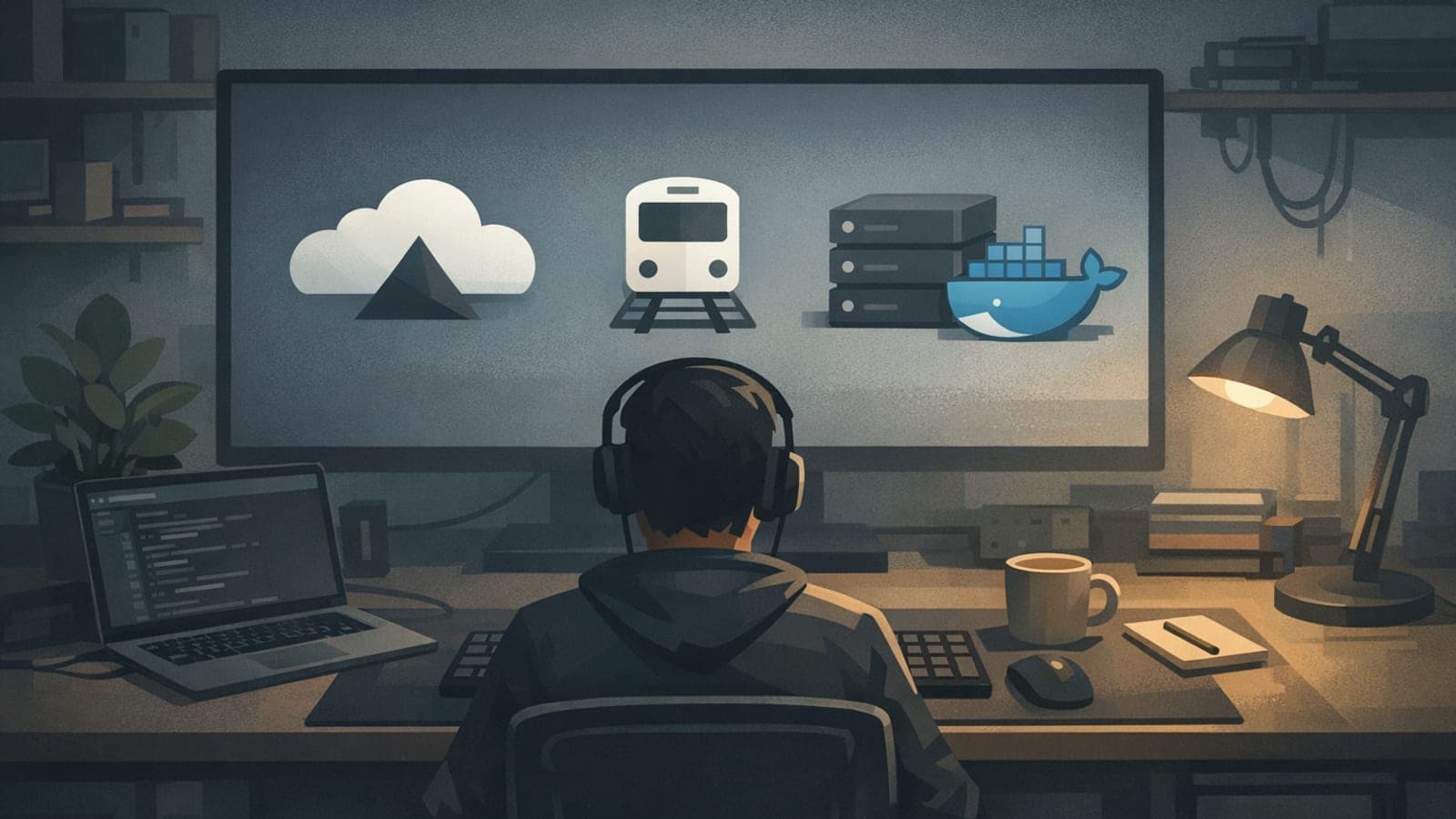
Indie devs often reach a fork: hand their app to a PaaS and focus on product, or self-host for control and potentially lower long-term cost. For Next.js + Node.js stacks the decision is nuanced—Vercel optimizes Next.js developer ergonomics, Railway provides simple full-stack hosting, and self-hosted Docker deployments offer maximum control. This article lays out an implementation-forward comparison focused on cost vs control vs complexity, provides a decision matrix you can apply to your project, and gives concrete next steps: CI/CD patterns, Docker best practices, and migration guidance tailored to solo devs and small teams.
1) Core trade-offs: cost vs control vs complexity
Make the decision through three lenses: cost (run and ops), control (customization, compliance, runtime), and complexity (setup and ongoing maintenance). No solution scores best on all three; your constraint set determines the right trade.
Vercel: very low complexity for Next.js, opinionated runtime optimized for serverless functions and edge middleware. Low time-to-market; costs increase if you need high runtime or background work. Railway: low-to-moderate complexity for full-stack apps with managed databases and simple autoscaling; more general-purpose than Vercel. Self-hosted: highest control and flexibility—choose OS, runtime, network, and infra—but expect more operational overhead and maintenance burden.
- Cost: Vercel (free-to-pro tiers; usage for serverless), Railway (free tier with pay-as-you-go), Self-hosted (VPS fees, managed DB costs, possible cloud bill if self-managing scaling).
- Control: Self-hosted > Railway > Vercel. Vercel intentionally abstracts infra details away.
- Complexity: Vercel < Railway < Self-hosted. Self-hosted requires backups, security, monitoring setup.
2) Next.js-specific considerations
Next.js has features that map to hosting choices: ISR (Incremental Static Regeneration), API routes, middleware, and edge functions. Vercel supports these natively, often delivering best-in-class DX (developer experience) and performance for Pages, ISR, and Edge Functions without extra infra work.
Railway can host Next.js as a Node server (next start) or as static plus API. It doesn't have first-class edge function support equivalent to Vercel, but it can run server processes and managed databases easily. Self-hosting gives you the flexibility to run Next.js however you want: Node server, custom caching, or your own CDN configuration, but you must implement ISR invalidation, edge-like behavior, and scaling policies yourself.
- If you rely heavily on Vercel features (Edge, Image Optimization, ISR defaults) and want minimal ops work -> Vercel.
- If your app is full-stack with persistent processes and managed DB needs -> Railway is simpler than self-hosting.
- If you require custom network topology, private infrastructure, or specialized hardware -> self-host.
3) Deployment patterns and practical configs
Use Docker as the canonical artifact for portability across platforms. For a Next.js + Node API monorepo, build a production image and push it in CI. Example minimal Dockerfile for a Next.js app using Node 18:
Dockerfile (concept): FROM node:18-alpine WORKDIR /app COPY package*.json . RUN npm ci COPY . . RUN npm run build EXPOSE 3000 CMD ["npm","start"]
Vercel: Deploy directly from Git. No Docker required. Add vercel.json for rewrites and builds if necessary. Railway: you can either deploy via Git (Railway handles build) or push a Docker image to their registry and define a service. Self-hosted: deploy Docker images to a VPS or orchestrator (docker-compose or Kubernetes). For a single server, docker-compose + systemd or a small Nomad cluster is pragmatic.
- CI: Use GitHub Actions to build and push an image to Docker Hub/GitHub Packages, and invoke deployment (Railway API, SSH deploy, or push to Vercel via Git).
- Secrets: Use the platform's secret store (Vercel env vars, Railway variables) or HashiCorp Vault / SOPS if self-hosting.
- Databases: Prefer managed Postgres for reliability; Railway provides managed DBs. For self-hosting consider Patroni or single-node Postgres with regular backups.
4) Operational checklist: scaling, backups, observability, and security
Regardless of host, you need running checks for scaling, backups, logs, and security. PaaS options add built-in solutions (automatic scaling, managed DB backups), while self-hosting requires you to assemble them.
Observability: Configure structured logs, request tracing, and error reporting. Vercel and Railway stream logs to their consoles, but integrating Sentry and a metrics pipeline (Prometheus + Grafana or a hosted metric store) is recommended for production-grade apps.
Backups & DR: Managed DBs usually include point-in-time recovery. For self-hosted Postgres, schedule pg_dump + WAL archiving to object storage (S3). Regularly test restore procedures; backups are only useful when validated.
- Scaling: Vercel scales serverless automatically; Railway gives autoscaling knobs; self-hosting requires horizontal scaling planning (load balancer + multiple app instances).
- Security: Rotate secrets, enforce TLS, use WAF/CDN in front of self-hosted apps, enable platform RLS/IP restrictions where applicable.
- Cost controls: Set alerts on usage, enforce container resource limits, and monitor database connection counts to avoid sudden bills.
5) Decision matrix and scoring example
Build a simple scoring matrix: assign weights for Cost, Control, Complexity, Time-to-Market, and Scalability needs. Score each hosting option 1–5 and multiply by weights. Example weights (adjust for your priorities): Cost 20%, Control 30%, Complexity 20%, Time-to-Market 20%, Scalability 10%.
A hypothetical early-stage SaaS (goal: rapid validation, low ops) might score: Vercel 4/5 cost, 3/5 control, 5/5 complexity (low), 5/5 time-to-market, 3/5 scalability -> weighted score ~4.2. Self-hosted could score higher on control but lower on time-to-market and complexity, resulting in a lower overall score for early stages.
- If your product must comply with strict data residency/ network controls -> self-hosted or cloud VPC with managed infra.
- If you want to iterate fast with minimal ops -> Vercel for frontend, Railway for backend + managed DB as a middle ground.
- If long-term cost and fine-grained control are top priorities and you can tolerate operations -> self-host and automate with IaC + CI.
6) Migration and hybrid strategies
You don't have to pick one forever. A common path: start on Vercel for frontend and Railway for backend/datastore, then move to self-host when scale or compliance demands arise. Because Docker is the artifact, you can minimize migration work by producing the same container image whether deploying to Railway or a VPS.
Steps for a low-friction migration: 1) Keep infra-agnostic app packaging (Docker image + env-driven config). 2) Avoid platform-specific APIs if you plan to leave (e.g., Vercel analytics or proprietary ISR invalidation hooks). 3) Mirror backups and test restores from day one. 4) Use feature flags to gradually switch traffic to new hosts.
- Example: Build image in GitHub Actions, deploy to Railway via registry and to self-hosted test environment simultaneously to verify compatibility.
- Configure abstractions in code for file uploads and caching so that you can plug in S3/Cloudflare/Filesystem with minimal code changes.
- Use database replication (logical replication or read replicas) during cutover windows to minimize downtime.
7) Practical recommendations by persona
Solo indie dev validating an MVP: Choose Vercel (frontend) + Railway (backend + Postgres) to minimize ops. Use free/pro tiers until you hit predictable usage. Automate builds via Git pushes and use platform secrets.
Small team building a growth-stage product: Evaluate a hybrid approach—Vercel for edge/frontend, Railway for devops-light backend, and consider moving to self-host when predictable traffic and cost justify ops investment.
Developer needing strict control/compliance: Self-host with Docker on a cloud VPS or a lightweight Kubernetes (k3s) cluster, add a managed CDN in front, and set up CI/CD to produce and deploy images automatically.
- Keep your Dockerfile and CI pipeline ready even if starting on PaaS: it pays off when migrating.
- Instrument observability from day one; logs and metrics are the most valuable debugging tools.
- Plan for database portability: avoid platform-locked extensions and document schema evolution/migrations.
Conclusion
There is no universally correct choice. Vercel wins when developer velocity and Next.js-first features matter most. Railway is the pragmatic middle ground for full-stack apps that need managed databases and simple scaling. Self-hosting is appropriate when you need complete control, compliance, or long-term cost optimizations and are willing to invest in ops. Use a simple weighted decision matrix against your priorities, package your app with Docker for portability, and instrument backups/observability from day one to keep migration options open.
Action Checklist
- Create a 5–10 line Dockerfile and a GitHub Actions workflow that builds and pushes your image to a registry; verify you can run the container locally.
- Make a decision matrix: list Cost, Control, Complexity, Time-to-Market, Scalability; assign weights, score Vercel/Railway/Self-hosted, and pick the highest scorer for your project.
- If starting on PaaS, still implement infra-agnostic patterns: env-based config, externalized storage (S3), and migration-friendly DB schemas.
- Set up basic observability: structured logs, an error tracker (Sentry), and a lightweight metrics endpoint. Hook logs/metrics into a central store.
- Plan a backup and restore test for your database now: schedule automated backups and perform a restore to a dev environment to validate the process.